Here’s something many parents don’t realize: the moment your child turns 18, you lose all legal authority to access their medical information, have input into healthcare decisions, or handle their financial matters – even if they’re still in high school, living under your roof, on your medical insurance or unconscious and unable to make their own decisions.
They are 18, so they are legal adults and should be (close to) ready to handle their own medical and financial matters. If they need your help, they can certainly ask. However, in the event of an emergency, if your young adult is unable to make decisions or give verbal authorization for you to be involved, you do not legally have the right to make important healthcare decisions or manage their financial obligations while they are incapacitated.
There are legal forms for 18-year-olds to put in place that will give you the authority to help when they are unable to help themselves. Below is a clear, parent-friendly guide to what your new 18-year-old should put in place, and options for how to get them done.
Click the banner to see the Mama Bear Young Adult POA package, and use code TDG20 for 20% off.
What Happens Legally When Your Child Turns 18
18 is the age of majority (adulthood) in 47 states. In Alabama and Nebraska, the age is 19, and in Mississippi, it is 21.
Once your child reaches the age of majority in your state, this means:
You cannot access their medical records. In some states, this occurs earlier than adulthood.
Their doctors cannot speak with you without the young adult’s consent, including for critical medical decisions.
You can’t manage their finances or sign documents on their behalf. Importantly, you can’t break a lease or stop charges from going to their credit card.
Colleges cannot share grades or academic issues with the young adult’s consent.
Yes, they may still be in high school and living under your roof, but this is the law, no matter the living situation or relationship. While some providers may choose to provide information or let you participate in medical decisions, they do so at their own legal risk.
The only way to ensure you can help in the event of an emergency is to have the young adult put legal documents in place naming an agent to act on their behalf when they are unable.
The 4 Essential Legal Forms For 18-Year-Olds
These are the 4 documents each young adult should consider to be sure a trusted loved one can help them if they are incapacitated.
Medical Power of Attorney & Advance Directive
The Medical Power of Attorney (aka Healthcare Power of Attorney) is the most important of the legal documents for 18-year-olds. It allows a young adult to name someone to make medical decisions if they are unconscious or otherwise unable to make their own decisions.
Accidents, injuries, illness, and mental health crises happen. Hospitals will need authorization to work with a third party for information sharing and decision-making, even a parent.
Please note that while you may have a less formal authorization on file at a doctor’s office or the campus medical clinic, it will not extend to other facilities. Most critical situations are treated in hospitals, and you can’t possibly pre-authorize every hospital.
The medical power of attorney should only go into effect if and when the young adult is incapacitated.
The Advance Healthcare Directive is essentially a living will and allows the young adult to state their wishes for medical treatment and life-sustaining care. It also designates end-of-life decisions. These are difficult decisions, and I recommend that the parents assist with completing this section, if not all the decisions involved in these documents.
Durable Power of Attorney (Financial/Legal Decisions)
Allows the young adult to name someone to handle financial or legal matters if needed.
If they aren’t able to pay their bills or stop recurring charges on their credit card, you’d need a court-appointed guardian, which isn’t easy, to step in and take care of these matters.
Please note that the durable power of attorney should be written so that it is only in effect if and when the young adult is incapacitated, unless the young adult prefers that the parents or designated agents have access at any time.
HIPAA Authorization Form
HIPAA (Health Insurance Portability and Accountability Act) is a U.S. federal law that establishes national requirements to protect patient health information from unauthorized disclosure, ensuring privacy and security.
You’ll need this signed document to speak with a doctor, receive medical updates, access test results, and communicate about treatment.
HIPAA applies to doctors, hospitals, clinics, insurance companies, and third-party companies working with medical information.
This is a simple one-page form that will be helpful to have in addition to the Medical Power of Attorney.
If you’re thinking, “My parents never needed these forms,” that is correct if you went to college before 1996. The HIPAA law was passed in 1996, and we’ve been signing those authorization forms before every doctor’s appointment ever since.
FERPA Release
FERPA (Family Educational Rights and Privacy Act) is a U.S. federal law that protects the privacy of student education records. For parents to have the right to access academic information such as grades, transcripts, and disciplinary records, a FERPA release must be in place.
This is completely optional and is not related to safety or emergencies. Our family opted out of a FERPA even though we are fully paying college tuition and expenses. We do have access to a parent portal that posts end-of-semester grades; this requires the student’s authorization, but not full FERPA access.
How To Get These Legal Forms Completed
This is where many parents may feel overwhelmed. Attorneys are expensive and maybe a little intimidating, but the process is fairly straightforward and can be simplified.
And as a reminder, these are the young adults’ forms, not yours to complete. The young adult must be present, fully understand the decisions, and then sign the documents. A couple of states require the agents (the parents, if that is who is named) also sign, but in most cases, it is just the 18-year-old.
Note that power of attorney forms vary by state. HIPAA and FERPA are federal laws, so those forms are national.
Prepare The Documents
To get the power of attorney documents prepared, your options include:
State government websites for blank forms – Be careful where you click if you’re doing a search for these, and be 100% sure you land on the actual state government page. There are scammers out there trying to capture this click and get you to pay for something you don’t need or gather your personal information. Not every state has these forms available online.
Your college – A few colleges offer a service to help students get these forms completed.
Your family attorney – There was a time when this was the only option. It is a great option, but it will be more expensive.
Your Employee Assistance Program at work – Some provide legal assistance as part of this benefit.
Online legal platforms (if you prefer a guided, but less expensive option) – An online legal platform, such as Mama Bear Legal Forms, is a good hybrid option between printing a blank form off the internet and having an attorney prepare the documents for you. If you use Mama Bear, use our promo code PSA20 to save 20% on the Young Adult Power of Attorney package.
Note: A generic form may not meet your state’s legal requirements. Always use your state-specific version to ensure it is valid.
What If My Student Goes To College In Another State
While many states will accept power of attorney documents from other states, if your student will be spending several years in another state, it is a good idea to have a power of attorney set up in that state as well.
One of our children attends college out of state. We used Mama Bear for both of our kids, and we were thankful that the second state was included at no extra charge.
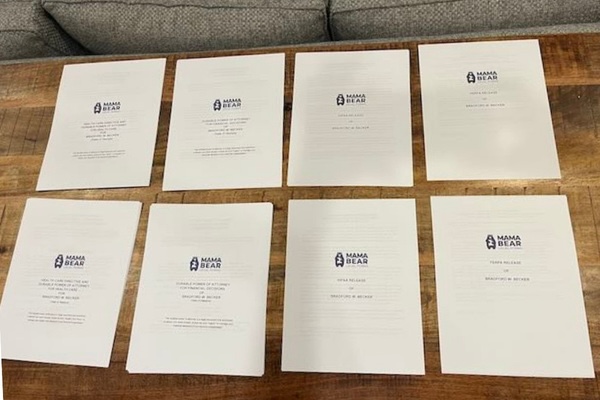
Fully executed legal documents for the home state and the college state.
Sign The Documents (But Not Without Reading This Section)
While these documents can be fully prepared before the student turns 18, they cannot be signed until the student has reached the age of majority for that state.
Most states require the documents to be notarized, so you cannot sign until you are in the presence of the Notary. Two witnesses will likely be required, and neither the young adult nor the agent may serve as a witness.
In some cases, documents must be signed in a specific order.
Where to find Notary services:
Banks
Credit unions
Courthouses
UPS stores
Some colleges – check with your Registrar’s Office
Please call ahead to determine whether there are any fees, whether an appointment is required, and whether you must bring your own witnesses.
Note: A Notary’s job to ensure that the people named in the documents are those people. They will not be able to answer questions about the documents or tell you whether they are right form for your state or completed correctly.
Scan, Store & Share Copies Of The Documents
After the originals are signed and notarized, keep them in a home safe or in a place where you store your important documents, passports, and valuables.
Before putting them away, though, take these steps:
Make paper copies. Send a copy of each document with the student to school. These should be stored safely but accessible to a roommate or friend if the hard-copy documents are needed quickly.
Create digital copies for phone access. Scan each document into a separate file on your home computer. Share these files with each named agent and the student. These files should be saved in an easy-to-find location on each phone so they are ready for emergency access. If you use our recommended online provider, Mama Bear Legal Forms, they have a free app with a scanning tool that each agent and the student may use.
Share a copy with your health providers. These may include the primary care physician at home and the college health center. Most emergencies will result in hospitalization, so while it is nice to have these forms filed with day-to-day medical practices, the most important step is to ensure printed and digital copies are easily accessible and readily available.
Do Powers Of Attorney Need To Be Renewed Regularly?
Almost all power of attorney documents have no expiration date and do not require renewal. For young adults, parents are typically named as agents and remain so until the owner of the documents marries.
Young Adult Power Of Attorney Common Misconceptions
1)My child turns 18 before or during senior year in high school, so I don’t need these documents yet, while they are still living at home.
=> Unfortunately, this does not guarantee you legal access to help them if they aren’t in a condition to give their consent for you to get information and make decisions.
2) My young adult is on our health insurance policy, so we’re covered.
=> While you may be able to get some information from your health insurance company (likely limited), but it certainly won’t be immediately available.
3) I am listed as my young adult’s emergency contact on the college’s emergency contact form and with their primary care doctor.
=> An emergency contact is just that – someone who is notified in the event of an emergency. This does not automatically grant you access to the details of the situation, although it can help. Keep in mind, though, most emergency situations are handled in a hospital, and your emergency contact designations cannot be transferred from their primary care doctor or college medical center.
4) I am the next of kin for my young adult, so I will receive all medical information and make the decisions.
=> While you are next of kin, legal privacy laws such as HIPAA prevent doctors from sharing information or allowing you to make decisions without proper legal documentation in place. The medical and financial POAs ensure you can act immediately without court intervention.
Conclusion
These forms are a one-time task that provides peace of mind for both parents and young adults.
This isn’t about control—it’s about being prepared for a worst-case scenario.
Takes less than an hour to set up and provides years of protection.
Completing these forms together is an opportunity to discuss wishes for medical care, safety and having trusted agents to make decisions and handle finances should the young adult be unable.
More Information For Parents of College-Bound Students
At The Dorm Guide, dorm & college life are what we do – every single day. We research and test products in our home dorm room, help families build affordable, realistic dorm shopping lists, and focus on comfort, safety, functionality, and reusability. We’re not about over-the-top or excessive decor or over-buying for your dorm room.
Subscribe to our weekly Dorm & College Newsletter with the latest news, how tos and the best deals of the week.
Affiliate Disclaimer: I only recommend products I do or would use myself. All opinions expressed are my own. I may receive a small commission, at no additional cost to you, for purchases made through the links in this post. Please see our full disclaimer for details.
Kimberlysays:
I so appreciate this! Just purchased the forms and filled them out. Saving them for the 18th birthday later this month and will be finding a notary near by. This is wonderful.







Kimberly says:
I so appreciate this! Just purchased the forms and filled them out. Saving them for the 18th birthday later this month and will be finding a notary near by. This is wonderful.
Lara Becker says:
You’re so welcome, so glad you’re getting this done – so many parents don’t realize how important this is!