When it comes to college dorm living, dorm beds are the priority for both planning and comfort.
In this topic, we’re delving into the layers of a college dorm bed and turning those uncomfortable dorm mattresses into a welcoming restful place to sleep.
In our Dorm Shopping & Deal Alerts Facebook Group, one of the most common group member questions is about the difference between a mattress topper and a mattress pad, a mattress cover, a mattress protector, or a mattress encasement. 🙂 Let’s take a look at how we define each of these mattress “helpers” and which layers you’ll need for college.
Anytime is a great time to learn all about making dorm beds more comfortable, but please don’t start shopping until you are certain of your dorm mattress size. We typically see Twin XL as the most common, but we also see regular Twin beds, Full beds, and Full XL beds across the country in college dorms. Your mattress topper, mattress pad, and fitted sheet MUST be the same size as your dorm mattress.
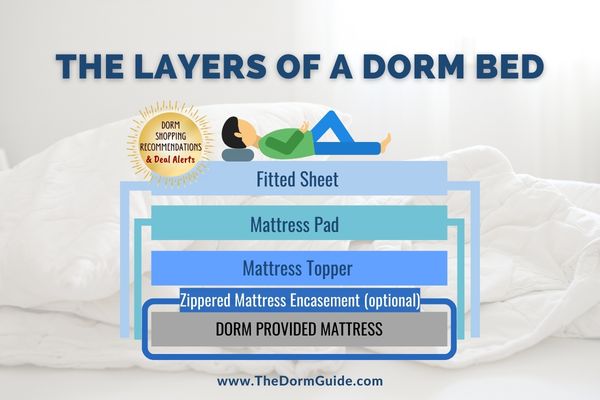
Let’s start with the easiest bed layer to differentiate – the mattress topper.
A mattress topper is most typically a 2″-4″ thick piece of memory foam. There are also other materials, such as latex or down, which are rarely discussed for dorms due to their expense. You may also see a ‘down-alternative’ topper with a couple of inches of thickness. Unless you have an aversion to memory foam, these are not a great choice as they tend to go flat or flatter over time.
Mattress toppers sometimes come with their own cover, usually one that can be unzipped and removed for washing. This is a nice-to-have, but not necessary, thanks to the mattress pads below.
Rarely, but they’re out there, memory foam toppers have an attached skirt or straps to help keep them in place. The skirt or straps go around the bottom of the mattress.
The thickness of the memory foam topper is directly related to the price tag. A 2″ topper costs less than a 3″ topper, which costs less than a 4″ topper, but don’t let the pricing fool you into thinking that the 4″ is the most premium or most desired.
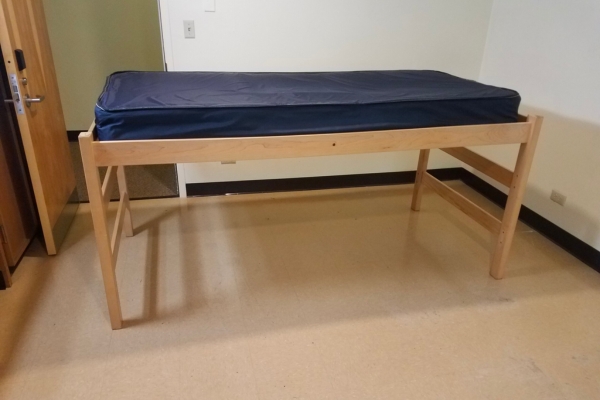
There are a few exceptions, but dorm mattresses are thin, springy, and covered in thick vinyl, which makes them easier to ‘clean’. These mattresses are sometimes called jail cell mattresses, and they just aren’t comfortable. Also, keep in mind that they are reused from one school year to the next. The statistics I’ve found say that dorm mattresses are used for anywhere from 8 years to when they’re pretty much unusable.
It does go over the dorm mattress, yes. Some families choose to put a layer between the dorm-provided mattress and their mattress topper. See the mattress encasement section below for more information on that layer.
There is a good bit to learn about toppers before you shop, so the entire next topic is dedicated to explaining what to look for and how to choose a dorm mattress topper.
A mattress pad is a quilted pad that sits on top of the mattress (and mattress topper) and has an elasticized bottom to keep it in place. It can provide some additional comfort, but often focuses more on protection (from stains or spills) rather than altering the feel of the mattress as a mattress topper does.
For toppers that do not come with their own cover, you will want a layer between the fitted sheet and the foam topper to both protect the topper and prevent you from feeling the foam through the sheet.
You can choose a standard or waterproof mattress pad, depending on the level of protection you need.
Mattress pads are sometimes called mattress covers, but we will use the term mattress pad throughout this website and in the Dorm Shopping Facebook group.
I have looked everywhere for a mattress pad made in the USA and have not been able to find one. Just about all are made overseas, primarily in China.
You must look for OEKO-TEX® certified when shopping for a mattress pad to ensure it is free of toxins. I’ve been preaching this for 2 years after reading about the manufacturing practices and toxic materials used in textiles made overseas. The good news is that it is becoming a bit easier to find OEKO-TEX®-certified textiles.
The mattress pad must also have a fully elasticized skirt. In other words, the elastic goes all the way around the ends and sides of the mattress pad, not just in the corners. This will help keep all of the layers from sliding out of place.
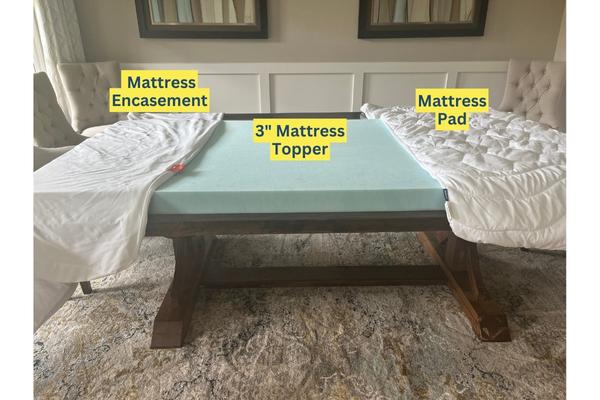
The mattress pad in the picture below is the OEKO-TEX® certified Bedsure Mattress Pad, which we highly recommend. Another breathable, cooling option that also gets great reviews is this Matbeby Mattress Pad. These are very similar, and I usually advise our group to choose the best-priced of the two at the time.
This SafeRest Waterproof Mattress Pad or this Quilted Waterproof Mattress Pad, are good options for a little extra protection.
A mattress encasement is a thin but strong, fully zippered encasement that goes completely around the mattress. It encases the mattress, providing a full barrier. Mattress encasements are often waterproof, allergen-proof, and bed bug-proof as they can fully seal off the mattress.
This is an optional bedding layer, but many choose to use a mattress encasement to zip away the school-provided used mattress.
PLEASE NOTE: Mattress topper companies recommend against putting your mattress topper inside a fully enclosed encasement, as the waterproof, sealed nature could cause mold or mildew to grow. Putting a mattress pad over a topper IS ok, as it still allows the topper to breathe. If you choose to use a mattress encasement, you want a very narrow profile encasement to surround the thin (5-8″) dorm mattress. A deeper mattress encasement will leave you with a lot of loose fabric, which could cause the mattress topper to slide around.
The ultra low profile (6″) encasement pictured above on the left is the Hospitology Ultra Low Profile Mattress Encasement. It will stretch to fit an 8″ dorm mattress, which my younger son currently has, and my older son used it on a 6″ dorm mattress, and it also fits well on that depth.
Another option, often at a better price, is the Utopia Bedding Zippered Mattress Encasement. Just be sure to get the 8″ for a typical dorm mattress – this size is not always available.
Mattress encasements are sometimes confused with mattress protectors. Mattress protectors are usually a cross between a mattress pad (without the quilt) and a mattress encasement, without being fully encased all the way around – only going around 3 sides like a mattress pad. I recommend against 3-sided thin mattress protectors, as you don’t get the quilted benefit of a pad or the full barrier protection of an encasement.
Most dorm mattresses are only 5-8” deep, whereas mattresses you have at home are 10”-12” deep. Add a 3” topper to your thin dorm mattress, and you’re at 8-11” deep.
Since your dorm mattress and the topper are a lower profile than a regular mattress, you do not need ‘deep pocket’ sheets. That said, it is hard to find sheets that don’t say ‘deep pocket’ these days. Apparently, all of the manufacturers think that is a selling point. Instead, look for the pocket depth in the product description. You may see ‘for mattresses up to 15″ deep’ or ‘for mattresses up to 18″ deep. You will be fine with the 15″ depth.
As with the mattress pad, I also recommend that the fitted sheet be fully elasticized to help keep everything in place, not just elasticized in the corners. A snug fit is helpful to keep all of the layers from sliding around on a vinyl-covered dorm mattress.
Twin XL sheets are typically marketed as ‘super soft’ college dorm sheets. It is true, those dorm sheets are super soft at first. They are microfiber (polyester), and they are soft and pretty inexpensive. There are 3 issues to be aware of, though.
1. Microfiber runs very warm. If your student is a warm or hot sleeper, they will not be comfortable sleeping on microfiber, no matter how soft it is!
2. Microfiber tends to be very absorbent and can therefore stain more easily. If you’ve seen sheets with darker spots on them, that’s from absorbing body lotions, oils, etc.
3. Microfiber fits well at first but tends to stretch. This can lead to the bedding layers sliding without a firm hold from both the fitted sheet and the mattress pad.
100% cotton sheets. They sleep cool, they are soft, and they won’t stretch.
There are many options out there, similar to microfiber, but you want to be sure they are OEKO-TEX® certified to avoid toxins in the fabric.
This is a great set of affordable 400TC 100% cotton sheets. And if you have a student who doesn’t use a top sheet like mine, you can just buy the fitted sheet!
We also love this set of 400TC 100% cotton sheets at Target. These have the added benefit of double elastic on the corners, helping keep that snug fit. These sheets also come in several print options.
For an upgraded thread count, the recommended Amazon brand also offers 600-thread count sheets and 800-thread count sheets.
Now that you know what to look for in each of the layers, this diagram shows how you go about layering a dorm bed.
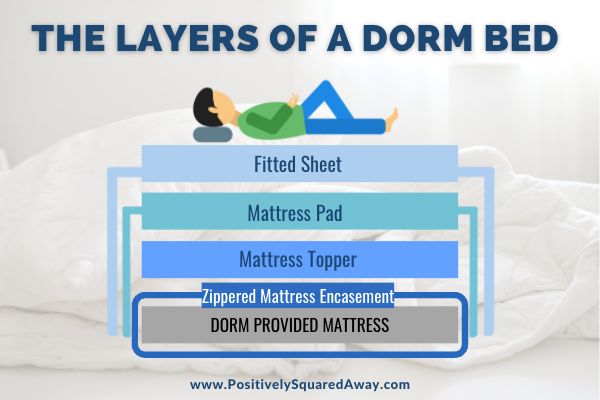
And that’s it! Follow this layering plan and our size guidelines to ensure your bed is perfectly made on move-in day and to support restful sleep throughout your time in a dorm. For more details on the layers and recommendations for each layer, please visit our full article How To Layer A Perfectly Comfortable Dorm Bed.
=> Please share this article with your dorm-bound friends and their parents using the sharing buttons on the left. I would love for everyone to be clear on these layers and the importance of non-toxic certifications before they start shopping!
Affiliate Disclaimer: I only recommend products I do or would use myself. All opinions expressed are my own. I may receive a small commission, at no additional cost to you, for purchases made through the links in this post. Please see our full disclaimer for details.
Smart shopping, real advice, and the best deals—delivered.
FOLLOW US ON SOCIAL

Jennifer Searing says:
do you recommend two sets of sheets or just one? what is normal?
Lara Becker says:
Hi Jennifer, I would suggest 2 sets. For those times when they hit the wall on “I really need to change my sheets” but don’t have time to do laundry, they’ll be thankful for that second set. I wouldn’t bring any more than 2 sets though – hopefully they’ll do laundry regularly!
Erin says:
Hi there! Do you recommend sleepyhead mattress toppers? Thanks!
Lara Becker says:
Hi, yes – these are our choice for premium mattress toppers. We usually have the largest discount code available in our Facebook group: https://www.facebook.com/groups/dormshoppingdealalerts. You can see all of our topper recommendations from budget to premium in this guide: https://thedormguide.com/dorm-iq-topic-4-how-to-choose-a-dorm-bed-mattress-topper/.
Chris says:
Hi! Any recommendations for where to find Full XL bedding? Thank you!
Lara Becker says:
Hi Chris, yes, and I should add a link to this guide, thank you for the nudge! Our Full XL recommendations are here: https://thedormguide.com/the-complete-dorm-room-essentials-list-with-recommendations/#FullXLBedding
Silvia says:
Do you recommend still getting a mattress pad for use on the sleepyhead toppers? We got the super topper and I see that it is optional to get a pad with that particular one but I am wondering what you would do?!
Lara Becker says:
I have used a non-waterproof mattress pad for tends to sleep sweaty son. I would definitely NOT use a waterproof mattress pad as that will add heat to the sleep environment, and Sleepyheads do a great job of keeping things cool!