Let’s deep dive into moisture, mold and the importance of air purifiers for dorm rooms.
College freshmen face a number of challenges as they start their new journey. New ‘home’, new roommate, new food, new freedoms, an academic wake-up call (for most), trying to find your people and make new friends. It is a lot. One thing you may not consider is the unwelcome challenge of battling sniffles and illnesses. Remember what it was like when they were in kindergarten? It’s like that again.
But this time, it may be caused not only by germs congregating in small dorm rooms, university buses, and crowded dining halls. Students are probably not getting enough sleep, maybe not eating well, and probably not taking those multivitamins you stashed in their first-aid kit. And are they hydrating?!
Colds and congestion are extremely common in the fall. You’ll just hope that it doesn’t get so bad that they miss or fall behind in classes. It is already so much harder than high school without missing class!
But when those sniffles and coughs never seem to go away, you may look to air quality and potential mold exposure as a possible culprit.
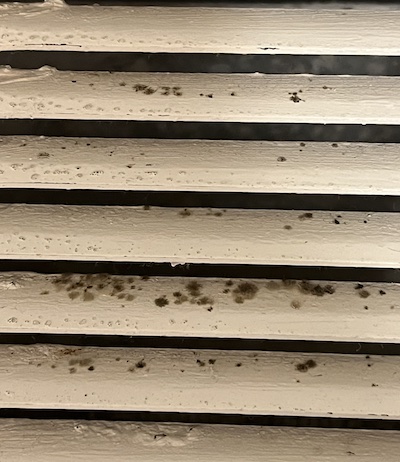
Mold is a fungus that grows in moist areas. In dorm rooms, there are a lot of damp places, unfortunately. The primary concern is the window heating & air unit or ceiling air vents. Mold also likes to grow in bathroom exhaust fans, in shower stalls, on shower curtains, under sinks, and in corners where damp towels have been piling up. Carpets or rugs that weren’t properly cleaned after a spill, and damp closets, can also be targets.
The problem with mold and college dorms is that you probably won’t see it before you feel the effects, especially if it is inside the vents, behind drywall, or in the ceiling of a tall, unlit closet.
Old buildings, poor air circulation, A/C cranking up condensation levels in the air vents, humidity, several showers a day in tiny bathrooms, it all adds up to the potential for mold. It isn’t just older buildings either. For reference, here is a list of news articles about mold in 145 college residence halls over the past 5 years.
Mold can hide very well in vents or walls. As mentioned above, you may not be able to see it. For any physical symptoms, please consult a medical professional.
*Source: CDC, July 2023
First and foremost, if your student isn’t feeling well and has symptoms, they should seek medical treatment. Testing may rule out common viruses and illnesses, but if the symptoms persist, additional action is warranted.
If at any time the student is concerned that mold is present, this should be reported to the University immediately. The student should contact their housing department or start out with their Resident Advisor (RA).
Have your student document each mold-related conversation and interaction, and keep a copy of any incident reports filed online. This is a good learning opportunity, and your student should take the lead on reporting and follow-ups unless there is no response or progress.
The good news is that there are ways to mitigate the risks of mold, germs, and illness with simple appliances in your dorm room.
An air purifier will clean the air of mold spores (certain models will) and germs, not to mention the smells that tend to form in small dorm rooms with dirty laundry, microwaved food, and multiple teenagers in tight spaces.
We’ve read many personal accounts in our Dorm Shopping Group from freshmen who were frequently sick or couldn’t shake off sickness in the fall semester. After doctor visits, meds, and head-scratching, someone would suggest trying an air purifier, and almost every time, there is a sudden improvement. Just do a simple Google search for ‘mold in dorms’, and you’ll find an astonishing number of pictures and reports.
A dehumidifier is another layer of protection in humid climates or for those dorms that just seem to be continually damp (many of them!). The dehumidifier will remove moisture from the dorm room and keep surfaces dry. This will also help your crunchy snacks and cereal stay crunchy!
Air purifiers continually remove bacteria, dust, smoke, mold spores, and pollen from the air through a filter before returning the cleaned air to the room. That filter, by the way, needs to be cleaned or replaced regularly.
We’ve done extensive research on air purifiers for dorm rooms and compiled the information below to compare popular, highly rated models for dorm-sized rooms.
Room size coverage
Most dorm rooms are in the 150-225sqft range (there are exceptions!). Choose an air purifier that can clean the air in your room about 4–5 times per hour (roughly every 12–15 minutes).
Air purifier brands advertise room coverage differently. Some list square footage per hour, while others list coverage for a single cleaning cycle. Look carefully at the details to understand what the unit can handle for your actual room size. Unfortunately, there is no consistency in how coverage is advertised. See the chart below for an apples-to-apples comparison.
Particle size removal
Mold spores, bacteria, and common allergens are typically 1–3 microns in size. Look for an air purifier that filters particles at least this small. Most quality air purifiers filter particles down to 0.3 microns or smaller.
Avoid UV or ozone-producing models
Some air purifiers use UV light or ionization technology that may generate ozone. Ozone is not recommended for small living spaces, such as dorm rooms, and can irritate the lungs. Look for models that are ozone-free or CARB-compliant.
Noise level
None are going to be silent, and some white noise in a dorm room is often a good thing, but noise level is something you should consider (and discuss with your roommate).
Filter cost
Filter replacement timing will vary by model and by how much is floating around your dorm room, and may need to be replaced ahead of a typical schedule, given the environment. Just check the cost and availability of replacement filters before buying the air purifier. Make a note to check the filter around Thanksgiving break. Sooner for notoriously dusty or pollen-prone dorms.
Smart technology and apps
While you may not be able to connect this to your school’s WiFi system when living on campus, you should be able to run it directly from the unit. For those who will likely move off campus during college, it makes sense to choose a reliable air purifier. An app to run, schedule, alert when it is time to replace the filter, and potentially monitor air quality is always helpful.
Built-in nightlights
A nightlight can be very handy when you and your roommate are on different schedules. Just be sure it can be turned off when you want true darkness! Why would you need a nightlight? Because the only lighting in a dorm room is usually a bright overhead light, which can make for a harsh awakening when your roommate gets home late in the evening.
True HEPA filters
True HEPA filters are considered the gold standard. They capture at least 99.97% of airborne particles like dust, pollen, mold spores, smoke, and pet dander. Some models list H13 or H14 HEPA, which are even higher-efficiency versions. For most dorm rooms, True HEPA provides excellent filtration.
HEPA-type or high-efficiency filters
These filters remove many airborne particles but are not certified as True HEPA. They can still work well for general dorm use, but may not provide the same level of filtration.
Activated carbon filters
Activated carbon helps remove odors, smoke, and gases. This is especially helpful in dorm rooms where food, laundry, or shared spaces can create lingering smells.
Pre-filters
A pre-filter captures larger particles, such as hair and dust, before they reach the main filter. This helps improve performance and extend the life of the primary filter.
Electrostatic filtration
Some air purifiers use electrically charged particles to capture pollutants (sometimes called ion-assisted filtration). These systems can help clean the air, but are not the same as True HEPA filtration. Only choose models that are ozone-free.
To make comparisons easier, we group these filter types into three performance tiers in our comparison chart below. This helps you quickly understand the level of filtration each air purifier provides.
Tier 1 – Certified HEPA
True HEPA, H13, or H14 filtration. Captures at least 99.97% of particles down to 0.3 microns. Best for allergies.
Tier 2 – HEPA-Grade
High-efficiency filtration, but not consistently certified True HEPA.
Tier 3 – Electrostatic Filtration
Ion-assisted particle capture systems. Effective airflow, but not equivalent to certified HEPA.
ACH (Air Changes Per Hour)
How often the purifier cleans all the air in a room. For dorm rooms, 4–5 air changes per hour is a strong performance.
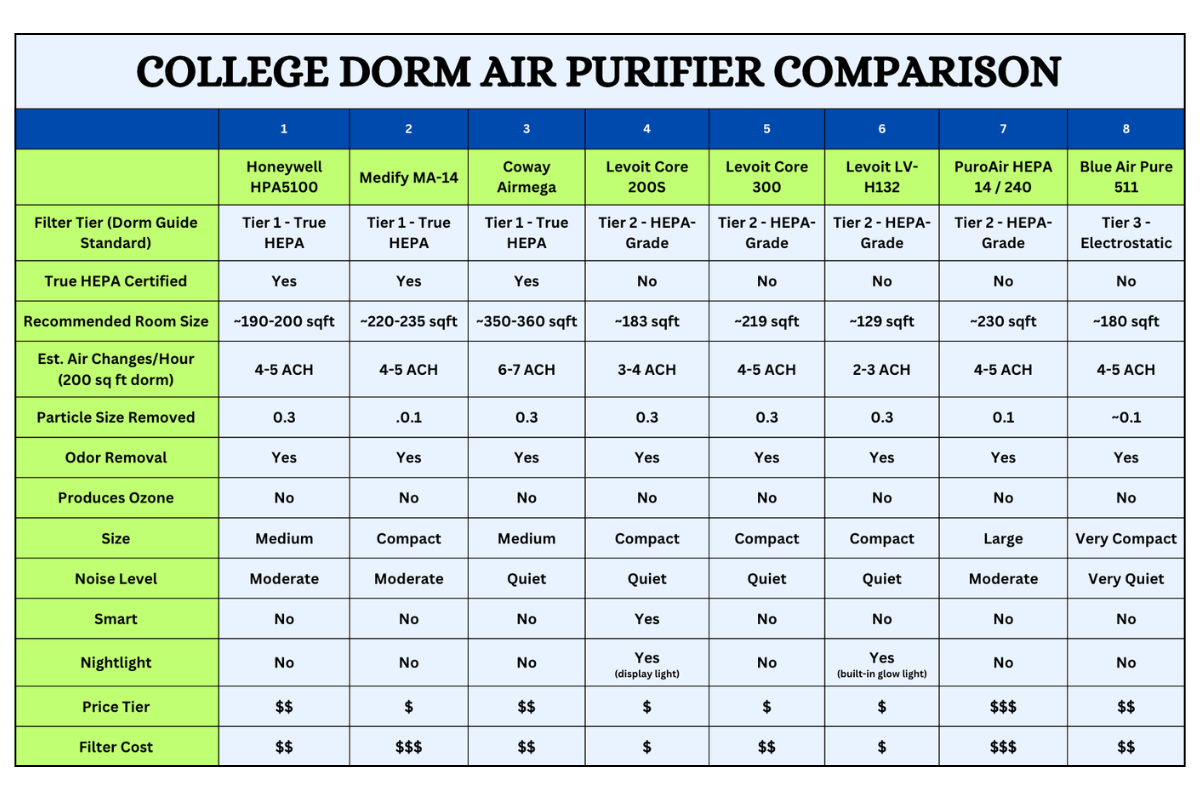
For most dorm rooms (about 150–225 sq ft), the best air purifier is one that provides strong air cleaning at a reasonable price without being oversized for the space. Here’s how our recommendations compare based on performance, size, and overall value.
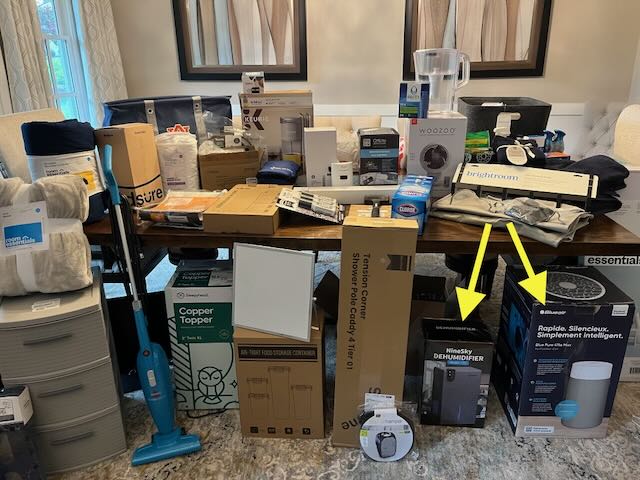
You should try to place the purifier closest to the source of pollutants. For many, this will be up high near the air vent. The top of a desk hutch or an over-the-fridge shelving unit may be a good option. In general, it should be more central in the room rather than in a corner.
A dehumidifier lowers the humidity in a room by collecting moisture from the air. The water collection chamber will need to be emptied regularly.
One simple way to remove moisture from the air is with DampRid buckets or DampRid Hanging Bags. Depending on the humidity levels in your dorm, these may suffice, but you need to watch them and replace them when they are full.
Our Facebook group members share many stories about walls that seem wet, clothes in closets that don’t feel fully dry, and, of course, the need to devour potato chip bags in one day because they become soggy by day two.
Unfortunately, there are not many highly-rated, affordable, effective dehumidifiers with decent-sized water chambers. I challenge you to find a well-rated, recognizable brand dehumidifier with a tank larger than 1 pint (16oz)! If you find one, please send me an email here! Well-rated = 4.5* or higher.
The NineSky Dehumidifier has an 85-oz tank (5.3 pints) and an auto shut-off. My son uses this in his 90-year-old dorm in Alabama, and he has to empty the tank every other day. If he doesn’t empty it, the auto shut-off kicks in, and they start to notice the dampness in the room quickly. This has made him good at making a routine to empty the chamber. It slides out easily and can be poured down a drain – it is only water.
One mom told us this story about her daughter’s freshman year experience:
“I call it a progressive journey. She chose a school in a very humid environment, so I suggested that I get her an air purifier and dehumidifier for her room. She adamantly declined, but she did “allow” me to get her DampRid Hanging Moisture Bags. I bought two boxes for a total of 6 hanging bags. She “allowed” me to hang one in the closet, one under the common suite sinks, one in the shower area, one in the water closet, and one under her bed. Her roommate’s mom used the 6th one for her daughter’s closet. Within two weeks, the bags were FULL, and I got a call asking to send more. I did the math. Instead of continually replacing the bags at about $4/each, I sent her the NineSky Dehumidifier that I had seen recommended on the Dorm Shopping Recommendations Facebook group.“
The complete opposite of a dehumidifier, humidifiers put moisture into the air. You need to fill a water chamber, and the device will consistently put that moisture into the air to increase the humidity in the room.
There are definitely situations where a humidifier would be helpful in a dorm room. If you live in a climate where the heat is going to run all winter long, that will have a tendency to dry out the air. If you live in a dry climate, such as in the Southwest, the combination of hot, dry outside temperatures and air conditioning running could also create an uncomfortably dry dorm room.
Humidifiers are also helpful for those suffering from a bad cold and congestion.
Fortunately, there are many affordable and highly rated options for humidifiers for dorm rooms. Here are a few good ones to consider.
While some humidifiers come with the option to add essential oils, we do not recommend this when using in a dorm room without the permission of your roommate(s). Many students are sensitive to fragrances.
When your student moves out of a dorm, their next step will most likely be an off-campus apartment, townhouse or house. Let’s face it, those dwellings are not necessarily new construction or luxury residences – they are typically older units, more affordable for students.
Air quality, germs, and roommates who make interesting food on the regular will all be reasons to keep that air purifier going in your bedroom year after year.
And if you live in the south, a dehumidifier may just make the temperatures more bearable in your apartment without spiking the electrical bill from turning down the A/C.
If you have time before move-in day, take these appliances out of their boxes. Open them up to see if any parts (like the air purifier filter) are in plastic wrap. We have seen so many students realize their filters had been in plastic for months while the air purifier was running, but not catching any germs, dust or mold!
Have your student read through the instructions, take out the air purifier filter, then put it back in. Take out the dehumidifier chamber as if you are pouring out the collected water. Plug them in and look at the settings and options. The more educated they are, the more likely they will be to use them properly! When you’re done, put them back in the protective styrofoam or packaging in their boxes for transportation to school.
The importance of controlling mold from thriving in a dorm room cannot be overstated. Air purifiers and dehumidifiers not only enhance your student’s overall comfort and well-being but also promote a healthier living environment by reducing moisture levels and filtering out pollutants. These essential appliances can create a healthier place for studying, relaxing, sleeping, and enjoying the college experience.
Our Dorm FAQs Article covers all of the questions frequently asked in our Dorm Shopping Recommendations & Deal Alerts Facebook group. The Facebook group is also a great source for prior years’ move-in pictures for decor and organizational ideas.
Our complete Dorm Shopping Guide is available here.
Still have questions? Please comment below, or come ask us in the Dorm Shopping Recommendations & Deal Alerts Facebook group. So much great info in the group along with hundreds, maybe thousands, of move-in pictures from previous years to give you ideas and inspiration.
=> Please share this article with your dorm-bound friends and their parents. I would love for everyone to understand the best air purifiers for dorm rooms before they start dorm shopping!
Affiliate Disclaimer: I only recommend products I do or would use myself. All opinions expressed are my own. I may receive a small commission, at no additional cost to you, for purchases made through the links in this post. Please see our full disclaimer for details.

Smart shopping, real advice, and the best deals—delivered.
FOLLOW US ON SOCIAL

Ewa says:
Thank you for sharing this! My daughter is headed to dorms known for mold due to the climate. What would you recommend cleaning the dorm
With on move in day to rid of the spores on the mattresses/vent/ walls etc?
Lara Becker says:
Hi Ewa – all of the steps for Move-In Day, starting with cleaning, are in this article: https://thedormguide.com/pack-for-dorm-college-move-in-day/. One of my kids moved into a 1934 dorm known for mold, and we cleaned the mattresses with Clorox wipes and vacuumed the room and the closets. Also used Clorox wipes on the vent under the window. We did not clean the walls. We found the room to be pretty clean on arrival, but I’ve heard nightmare stories and was ready for almost anything! They had a great year, no mold. Be sure to keep all furniture and other items at least a foot or two away from vents.
Lady_g says:
I know it’s a problem if you buy too small of an air purifier, but is there a problem if the air purifier covers a larger area than the size of a dorm?
Lara Becker says:
This is not a problem at all, and in fact, it might be helpful to have a larger size for later college or post-college years in apartments or rental houses.
Shari Gillett says:
What are your thoughts on the Shark air purifier. The small one that you do not need to replace the filter for up to 5 years.
Lara Becker says:
Hi Shari, that one cleans 250sqft per hour. So as this article states, it needs to clean the square footage of your room every 15 minutes. This means that this Compact Shark Air Purifier is appropriate for about a 62sqft room which is much smaller than a dorm room unless you’re in a small single. In my opinion, it is far too expensive for the size room it can handle.
Silvia says:
Do you have a recommendation for an air purifier/humidifier combo for a dorm room? We live in Montana and it is very dry.
Lara Becker says:
I recommend separate appliances for an air purifier, humidifier, and dehumidifier. There really isn’t one appliance that does a good job at more than 1 function.